
Logan Luna

Logan Luna

Computer Scientist &
AI for Math Researcher

I study how semantically informative training signals can be quantified and incorporated into the training and generation of mathematical reasoning models.

  • M.S. Computer Science, Georgia Institute of Technology, advised by Vijay Ganesh
  • Research Collaborator V, supporting Meta FAIR on the ATLAS project
  • B.S. Computer Science, Embry-Riddle Aeronautical University (Honors)
  • DoW SMART Scholar, Scientist Intern at NSWCDD

Symbolic feedback rewards output that compiles or type-checks, but that does not certify that it expresses the intended mathematics.

Erdős's conjecture on large totient fibers

Full replay →
A real 21-hour orchestration run, replayed from its trace on a compressed clock: each dot is a lemma, filling green as Lean accepts AIProver's proof. Conditional on the smooth shifted primes hypothesis (H).
News
New

Started a contract role supporting Meta FAIR as a Research Collaborator V, contributing to the ATLAS project. ATLAS, the Autoformalized Textbook Library At Scale, is a verified Lean 4 library built with AutoformBot, an open-source multi-agent framework that translates informal textbook mathematics into machine-checked definitions and proofs.

Earlier news
  • SensorWF: A FAIR Generalizable Workflow Framework for Scientific Time-Series Analysis accepted to the ReWorDS Workshop at the IEEE International Conference on e-Science (eScience) 2026.
  • Interned at NSWCDD, continuing work on real-time autonomous tracking systems.
  • Graduated magna cum laude with a B.S. in Computer Science from Embry-Riddle Aeronautical University.
  • Named Embry-Riddle's Outstanding Undergraduate in Computer Science.
  • Awarded a $24,000 Center for Aerospace Resilient Systems (CARS) Research Grant for AI for Data Anomaly Detection in a Satellite Learning Laboratory (SATLL).
  • Satellite Trajectory Optimization via Proximal Policy Optimization for Space Debris Avoidance published in IEEE Access.
  • Embry‑Riddle Undergrads Develop ‘Guard Dog’ System to Ward Off Cyberattacks
  • Dueling Deep Q-Learning for Intrusion Detection accepted to IEEE SoutheastCon 2025 (IEEE-Eta Kappa Nu Best Paper Award).
  • Began DoD internship at NSWCDD for computer vision systems.
  • Awarded DoD SMART Scholarship.

Research

Select Papers

  1. AIProver: Agentic Auto-Formalization of Mathematical Research via Certificate-Driven Evolving Harness

    Under reviewICLR 2027

    Prithwish Jana, Viet Bach Hoang, Logan Luna, Viresh Pati, Akash Singirikonda, Cy Xie, Lisa Carbone, Wuyang Chen, Walter Moreira, Joe Stubbs, Sriram Vishwanath, Vijay Ganesh.

    Contribution: RL pipeline and reward, BEq+ extension, distillation pipeline and dataset, Semantic Alignment Model. Results: pass@4 semantic correctness from 15.7% to 36.7% standalone (above GPT-5.6-Sol and Codex); 41.9% to 79.8% as a Claude Code skill.

    Fig. 1. An illustrative AIProver session: an English theorem becomes Lean, is repaired from Lean's own error with a Mathlib lemma, and is checked against the English. Above the file, the training stage behind each step lights up; choose one to see it.
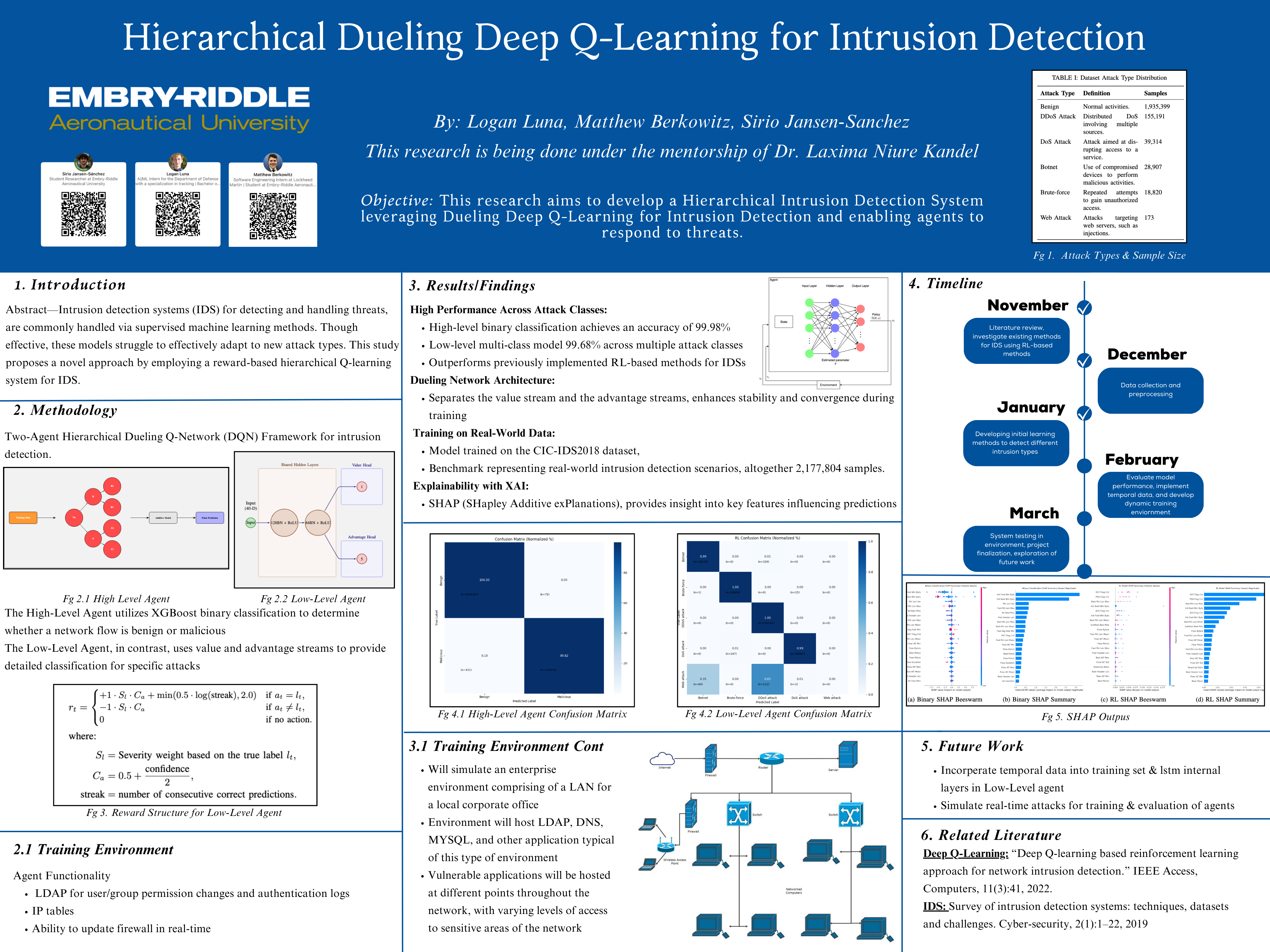
  2. Dueling Deep Q-Learning for Intrusion Detection

    ConferenceIEEE SoutheastCon 2025, Best Paper Award

    Logan Luna, Matthew P. Berkowitz, Laxima Niure Kandel, Sirio Jansen-Sánchez.

    99.68% multi-class accuracy on 2.18M CIC-IDS2018 flows, against 88% for prior DQN-based detection and 98.4–99% for tree-ensemble and random-forest IDSs; SHAP attribution of the learned policy.

    Fig. 2. A flow arrives as packets and its features are read off them. Benign flows leave at the XGBoost screen; malicious ones pass the dueling Q-network, where each class rises or falls from the value line V(s) to its Q-value and the highest names the attack. Flows are illustrative; recall is the real CIC-IDS2018 result.
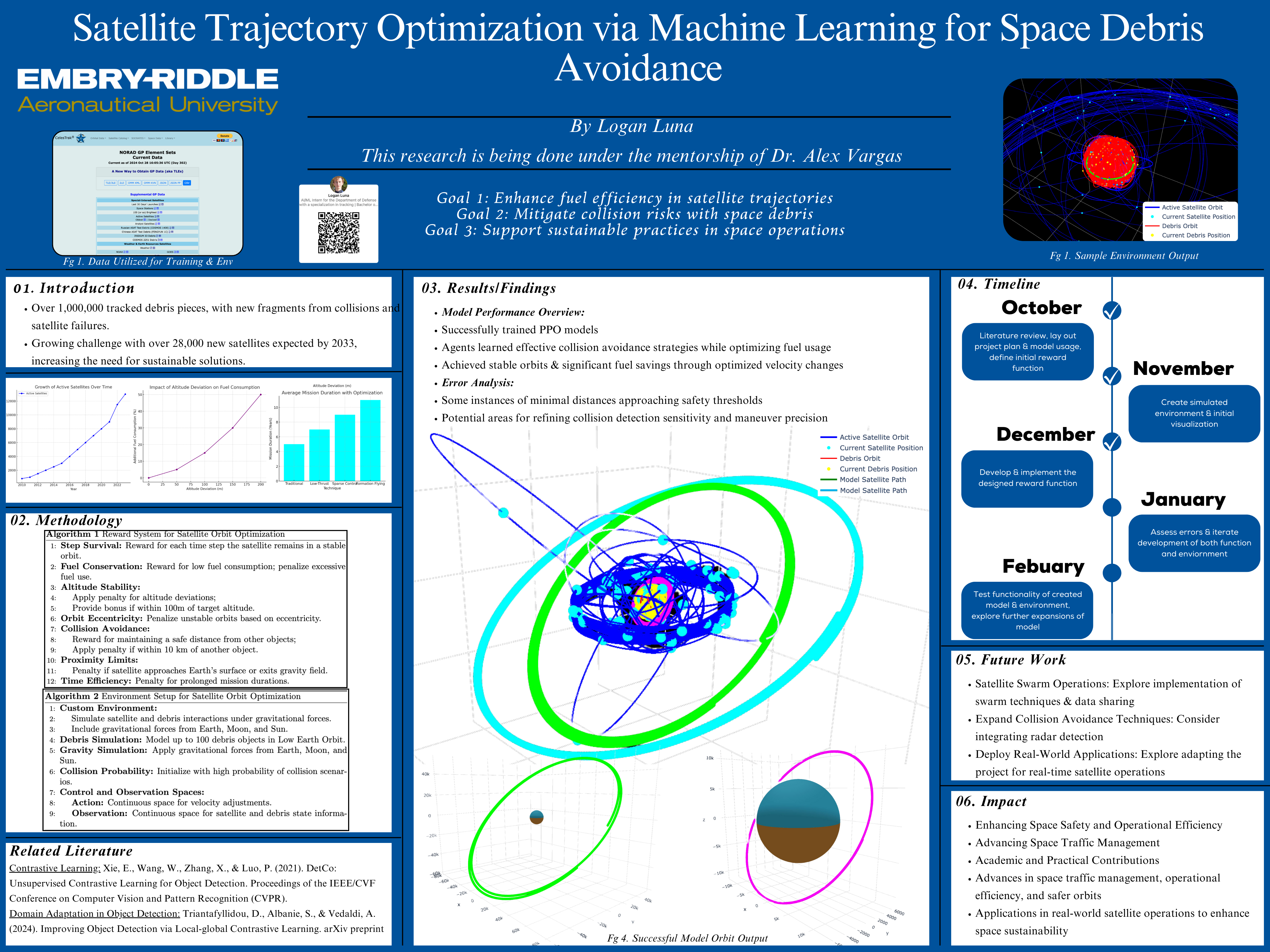
  3. Satellite Trajectory Optimization via Proximal Policy Optimization for Space Debris Avoidance

    JournalIEEE Access, 2026

    Logan Luna, Juan Ortiz Couder, Raul Alejandro Vargas-Acosta.

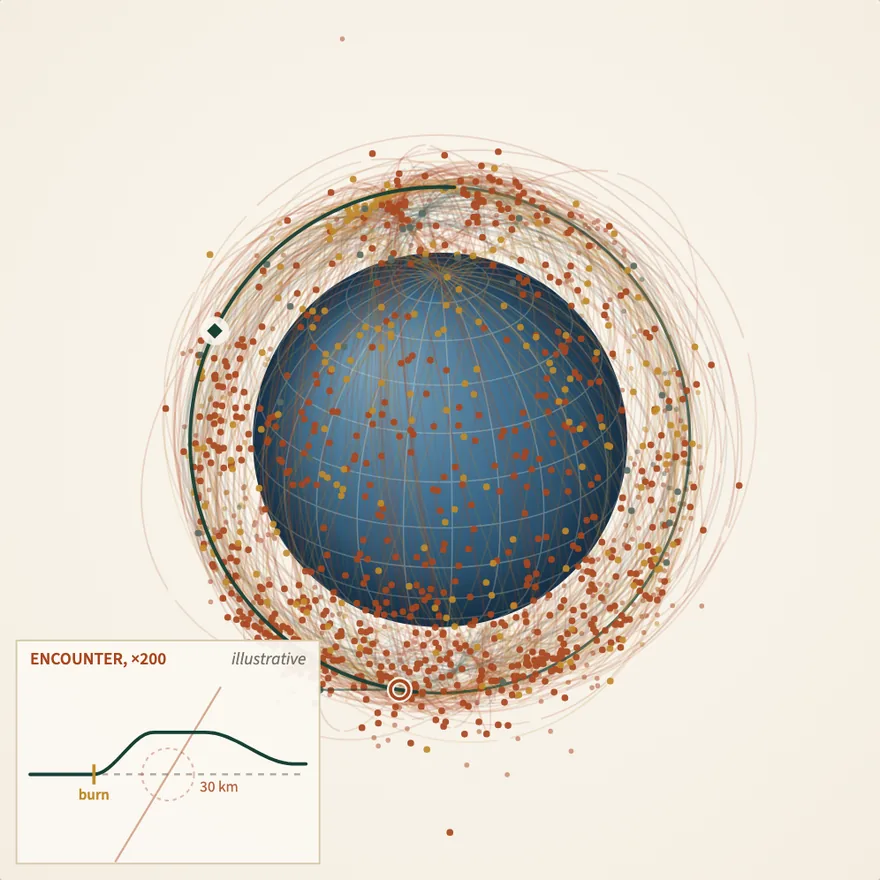
    97.5% collision-avoidance success over 1,000 deterministic GEO episodes, 76.8 and 70.0 percentage points above the rule-based and impulsive Δv baselines.

    Globe surrounded by orbiting debris fragments from the Fengyun-1C, Cosmos 2251 and Iridium 33 breakups
    Fig. 3. Tracked debris from the Fengyun-1C, Cosmos 2251 and Iridium 33 breakups, with an illustrative avoidance manoeuvre magnified in the inset.
  4. Direct Policy Transfer from Simulator to Firmware: Verification Boundaries for Learned UAV Autonomy

    Under reviewACM International Conference on Trustworthy and Responsible AI and Computing Systems

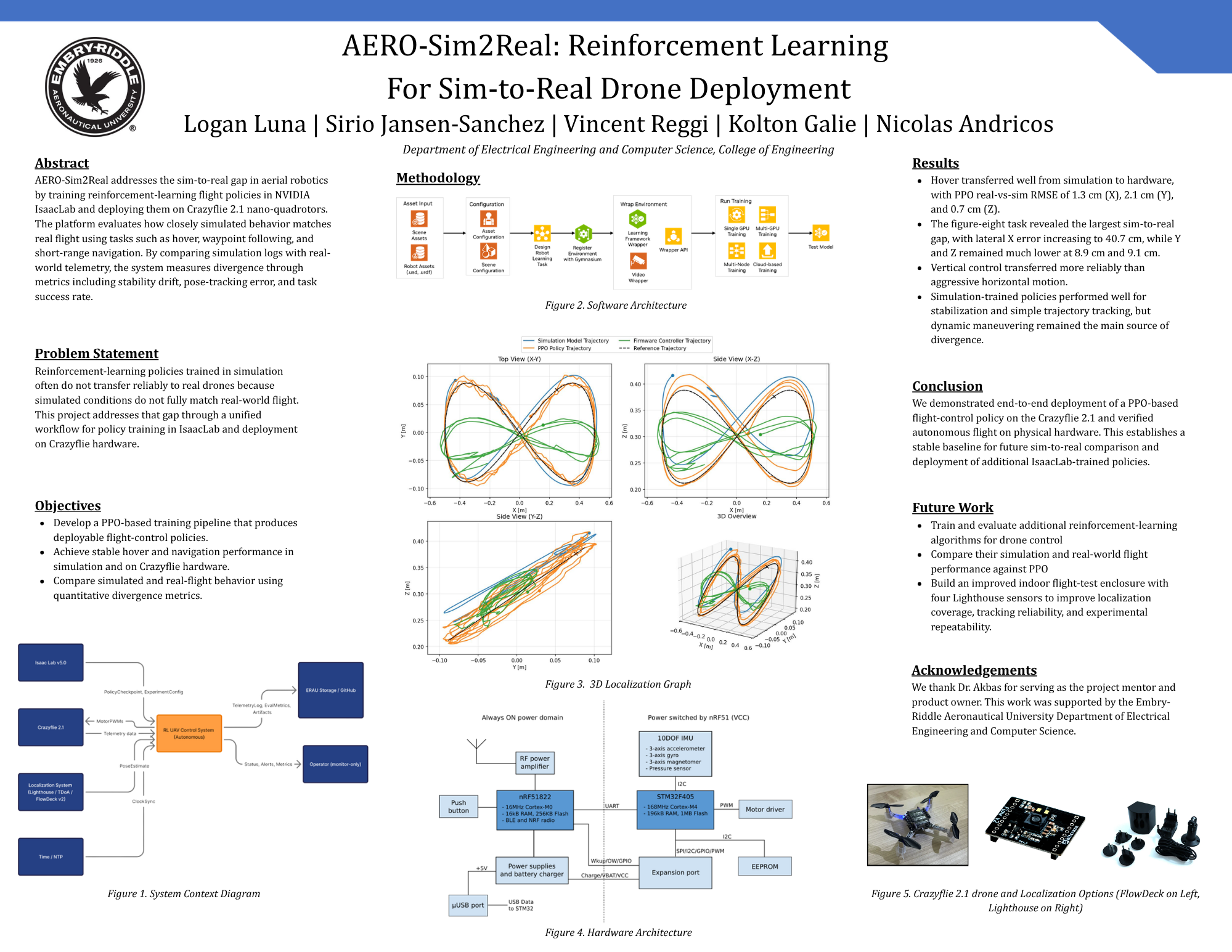
    Illia Biblyi, Elsy Fuentes Montiel, Andressa C. Ojeda, Logan Luna, Kolton Galie, Vincent Reggi, Nicolas Andricos, Sirio Jansen-Sánchez, M. Ilhan Akbas.

    A verification framework for compiling Isaac Lab policies directly into Crazyflie nano-UAV firmware, with executable checks from observation replay to source-to-binary traceability; 2–3 cm hover altitude error onboard.

    Fig. 4. One policy flies the same plan in simulation and on the Crazyflie. The real drone's drift is drawn four times larger; the inset gives it in centimetres. Illustrative tracks.
  5. Signal-Centric Remote Sensing via Alternative Preprocessing and Acoustic Processing for ML-Driven Applications

    ConferenceIEEE SoutheastCon 2025, Concord, NC

    Logan Luna, Sirio Jansen-Sánchez, Ilteris Demirkiran, Leo Ghelarducci.

    91.2% reduction in total sonar processing time (13.1% in filtering alone) against image-based CV processing, while preserving target structure the image pipeline removed.

    Fig. 5. One sonar sweep past an underwater gate, cleaned two ways. Filtering the raw signal keeps the gate echo in 3.1 ms; rendering images first takes 37.4 ms and erases it. Waterfalls and timings from the paper, slowed down.
  6. SensorWF: A FAIR Generalizable Workflow Framework for Scientific Time-Series Analysis

    WorkshopIEEE eScience 2026 (ReWorDS Workshop), Naples, Italy

    Logan Luna, Joseph Rigo, Kellan Shew, Raul Alejandro Vargas-Acosta.

    One analytical core carried across spacecraft telemetry, ECG, and climate data with small domain adapters and no core changes; bit-identical outputs under fixed seeds.

    Fig. 6. Real spacecraft, ECG and weather recordings, each read by its own small adapter (M1), then marked by the same unchanged modules M2 to M5.
View All Publications

Research Posters

AERO-Sim2Real poster 2026

AERO-Sim2Real: Reinforcement Learning For Sim-to-Real Drone Deployment

Satellite trajectory research poster 2024

Satellite Trajectory Research Poster

Hierarchical Dueling Q-Learning poster 2024

Hierarchical Dueling Q-Learning for Intrusion Detection

Aircraft detection and Kalman tracking poster 2023

Aircraft Detection & Kalman Tracking Poster

Research

Current Research Directions

AI4Math

Reinforcement learning from symbolic and semantic-equivalence feedback for auto-formalization

AI4Math

Dense rewards from distance in a learned proof-semantic space, grounded in kernel-checked entailment

AI4Math

Diffusion language models for theorem proving and auto-formalization

Earlier work

Reinforcement learning for safety-critical systems